~Luke 12.1 Meanwhile, when a crowd of many thousands had gathered, so that they were trampling on one another, Jesus began to speak first to his disciples, saying: “Be on your guard against the yeast of the Pharisees, which is hypocrisy.
Yeast and its relationship to health is a complex topic I don't know much about. It can be harmful to the body when present in abnormally high quantities. Jesus uses it as a metaphor for hypocrisy. I always thought that was just because yeast can grow and spread, but there could be more to it. I think we will see yeast again.
Monday, July 11, 2011

Friday, July 8, 2011

We have joined a CSA (Community Supported Agriculture) this year with the purchase of a share of a farmer's harvest for this season. That means every week I pick up a bunch of local, fresh vegetables. Here's this week's haul: Italian parsley, zucchini and summer squash, Tuscan kale, radicchio, green onions, broccoli, kohlrabi with tops and a cute little cabbage. Love it!
I don't know yet if any of this is specifically mentioned in the Bible, but I do know that God made it, not a food processing plant. :-]
Wednesday, July 6, 2011
Herb Garden
~Luke 11.42 “Woe to you Pharisees, because you give God a tenth of your mint, rue and all other kinds of garden herbs, but you neglect justice and the love of God. You should have practiced the latter without leaving the former undone.
Herbs add so much flavor and variety to food. Mint is delightfully light and refreshing. Rue I know little of, but read that it has a "pleasant musky flavor" and can also serve as a bitter medicinal herb, "excellent protection against plagues and pestilence, and used . . . to ward off poisons and fleas" http://www.mountainroseherbs.com/learn/rue.php. So apparently the choice of these two would cover a range of culinary and medicinal plants. Jesus here gives no evaluation of herbs, but just a glimpse of the fact that they were commonly grown and used.
Herbs add so much flavor and variety to food. Mint is delightfully light and refreshing. Rue I know little of, but read that it has a "pleasant musky flavor" and can also serve as a bitter medicinal herb, "excellent protection against plagues and pestilence, and used . . . to ward off poisons and fleas" http://www.mountainroseherbs.com/learn/rue.php. So apparently the choice of these two would cover a range of culinary and medicinal plants. Jesus here gives no evaluation of herbs, but just a glimpse of the fact that they were commonly grown and used.
Monday, July 4, 2011
~Luke 11.37-41 As Jesus was speaking, one of the Pharisees invited him home for a meal. So he went in and took his place at the table. His host was amazed to see that he sat down to eat without first performing the hand-washing ceremony required by Jewish custom. Then the Lord said to him, “You Pharisees are so careful to clean the outside of the cup and the dish, but inside you are filthy—full of greed and wickedness! Fools! Didn’t God make the inside as well as the outside? So clean the inside by giving gifts to the poor, and you will be clean all over.
Another shared meal, but, alas, not a word about the food.
Another shared meal, but, alas, not a word about the food.
Friday, July 1, 2011
Mother's Milk and Calcium
~Luke 11.27-28
I used to drink a lot of milk in the belief that the calcium was good for my bones. I also took multiple calcium pills every day. The result? Bone density continued to drop. Obviously, my body wasn't absorbing that mineral from those sources. Now I'm trying to eat more non-dairy calcium sources, but I wonder if I'm getting enough. One can only put so many leafy greens and sesame seeds into a day.
As he was speaking, a woman in the crowd called out, “God bless your mother—-the womb from which you came, and the breasts that nursed you!”” Drinking cows' milk may be controversial, but mother's milk is clearly a good start for babies. Since adults don't have this option, we have been led to embrace cows' milk as a suitable substitute, something questioned by many nutritionists.
Jesus replied, “But even more blessed are all who hear the word of God and put it into practice.
I used to drink a lot of milk in the belief that the calcium was good for my bones. I also took multiple calcium pills every day. The result? Bone density continued to drop. Obviously, my body wasn't absorbing that mineral from those sources. Now I'm trying to eat more non-dairy calcium sources, but I wonder if I'm getting enough. One can only put so many leafy greens and sesame seeds into a day.
Wednesday, June 29, 2011
Cavemen ate no bread, so . . . .
Bread has so many positive mentions in the Bible that I want to throw in a word here about a current dietary trend that does not allow bread, the paleolithic diet. Some people's search for optimal health or for relief from various allergies leads them to this diet. It consists of only foods hunter-gatherer, pre-agricultural cave men would have had available to eat: meat and eggs, vegetables, fruits, nuts and seeds, maybe some olive oil or nut oils. That's about it. Glaringly absent from this list is grains (wheat, rice, corn) and legumes (beans, peas, lentils, soy, peanuts). As I understand it, since these foods cannot be eaten raw they are not accepted as something early man would have eaten and therefore not accepted as part of the optimal diet for humans. Paleo-eaters say GOOD-BYE to the 1990s VERSION FOOD PYRAMID
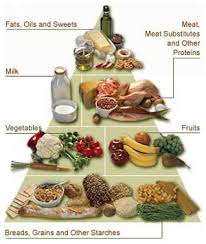
Specific to bone density, I have read in a few places that too much of the fiber found in grains and legumes can interfere with calcium absorption and therefore contribute to weaker bones. I will continue to avoid white flour, which seems to be everywhere in our U.S. diet (pasta, buns, snacks, cookies). But based on the Bible's clear blessing on eating bread (whole grain bread) as a good thing I am deciding now to not worry about cutting out or drastically reducing grain consumption. Jesus blessed bread and that's good enough for me.
Specific to bone density, I have read in a few places that too much of the fiber found in grains and legumes can interfere with calcium absorption and therefore contribute to weaker bones. I will continue to avoid white flour, which seems to be everywhere in our U.S. diet (pasta, buns, snacks, cookies). But based on the Bible's clear blessing on eating bread (whole grain bread) as a good thing I am deciding now to not worry about cutting out or drastically reducing grain consumption. Jesus blessed bread and that's good enough for me.
"Shameless Audacity" Rewarded
~Luke 11.5-8 Then Jesus said to them, “Suppose you have a friend, and you go to him at midnight and say, ‘Friend, lend me three loaves of bread; a friend of mine on a journey has come to me, and I have no food to offer him.’ And suppose the one inside answers, ‘Don’t bother me. The door is already locked, and my children and I are in bed. I can’t get up and give you anything.’ I tell you, even though he will not get up and give you the bread because of friendship, yet because of your shameless audacity he will surely get up and give you as much as you need.
Another translation says "shameless persistence." So like the widow before the corrupt judge (Luke 18), this is another keep-on-asking-and-never-give-up story.
But what can I learn here about what to eat? Like the hero in this story, sometimes people go to bed with no food in the house. Thankfully I have never done this.
If a late night guest shows up, the staple of bread is appropriate to offer. If there's no bread, go and with shameless audacity ask a neighbor for some.
Another translation says "shameless persistence." So like the widow before the corrupt judge (Luke 18), this is another keep-on-asking-and-never-give-up story.
But what can I learn here about what to eat? Like the hero in this story, sometimes people go to bed with no food in the house. Thankfully I have never done this.
If a late night guest shows up, the staple of bread is appropriate to offer. If there's no bread, go and with shameless audacity ask a neighbor for some.
Subscribe to:
Posts (Atom)